Behind the sound
Geekz
The Lost Boyz get a lot of questions about their sound and how the equipment works, so here is the secret behind the scenes.
Read this first
Do not undertake any modification or build project unless you know what you are doing. Doing so could result in severe damage to the equipment, or in serious harm to you. Some equipment can store extremely high voltages even after it has been disconnected from the mains.
This page is for general interest. It is not a how-to guide. The Lost Boyz accept no responsibility for anyone who tries to replicate what they see here.
Live sound
The sound system is a Bose L1 Pro16 tower connected to a Bose TS8 mixing desk. Every device and instrument plugs into the TS8 and the mix is set from there. Also from the TS8 there are two Mackie SRM450 powered speakers doing front of house. Sound comes from the left, the right and the middle of the stage, which gives the boyz a stereo kind of sound.
The Lost Boyz use backing tracks, as there is obviously only Andrew and Darren in the band. Backing tracks are only used for the electric sets though, not the acoustic part — they like to play the acoustic set as a duo. More on that further down.
Acoustic guitars, and amplification
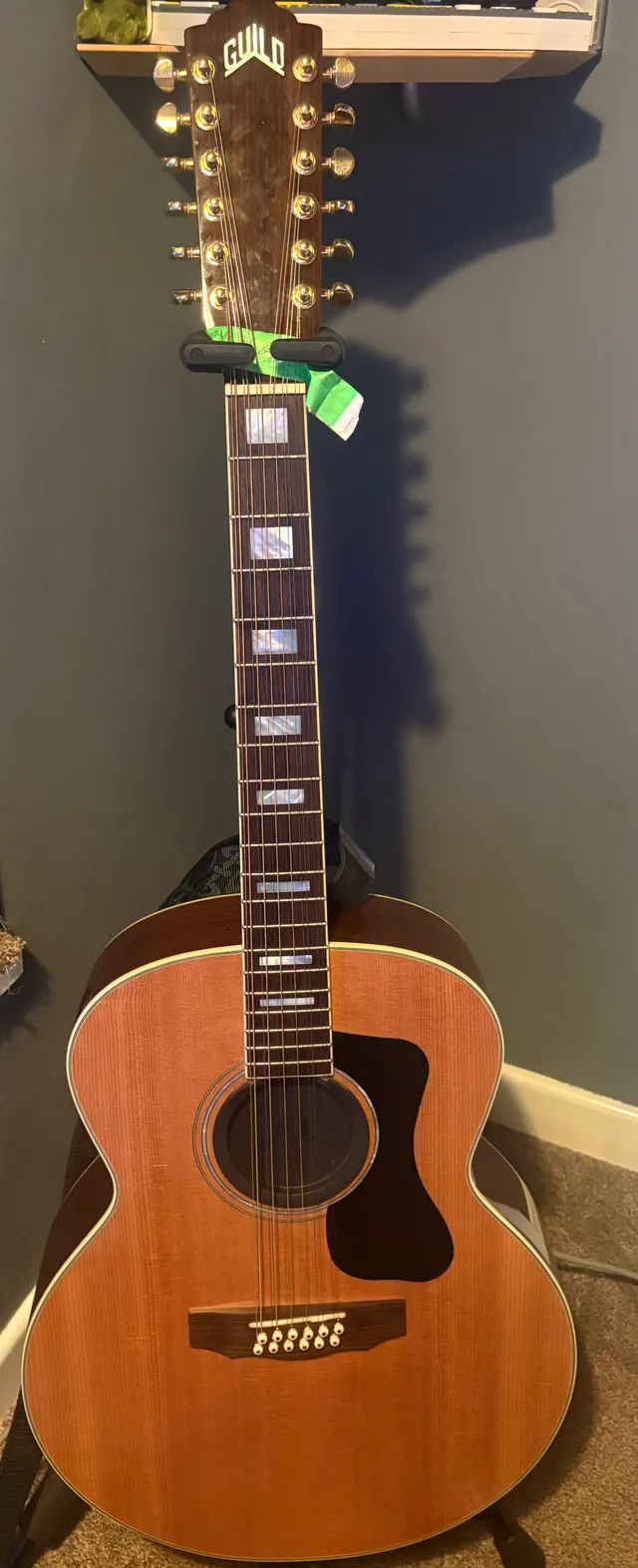
Darren's guitar of choice for the acoustic set is the Guild F-2512E twelve-string electro-acoustic, with a D'Addario feedback destroyer covering the sound hole to keep out any unwanted noise, and D'Addario 10–46 strings.
That goes into the Line 6 Helix, where he uses only some subtle effects — chorus, delay, reverb and a graphic EQ on some of the songs to thicken up the mix. From the Helix the signal goes straight to a Marshall AS50R 50w acoustic guitar amplifier. The amp is then connected to the Bose TS8 through the DI output on the back, so the mix can be controlled from the desk and the amp itself works as a stage monitor for Darren.
Electric guitars — Kyle and Timmy
Darren plays two heavily modified Paul Reed Smith Tremonti signature guitars with D'Addario 9–46 strings. Both are exactly the same, and they are named Timmy and Kyle in honour of the lost boys. The electrics plug straight into the Helix, and from there the signal goes straight to the Bose TS8.
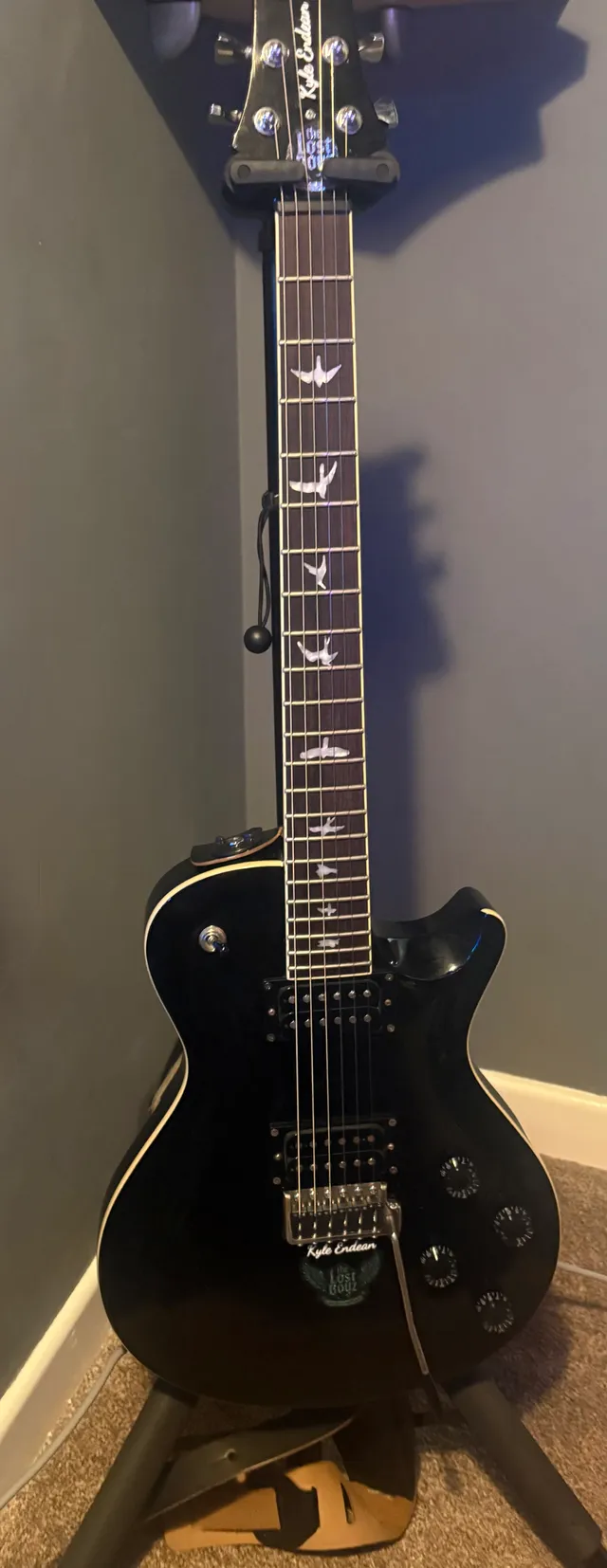
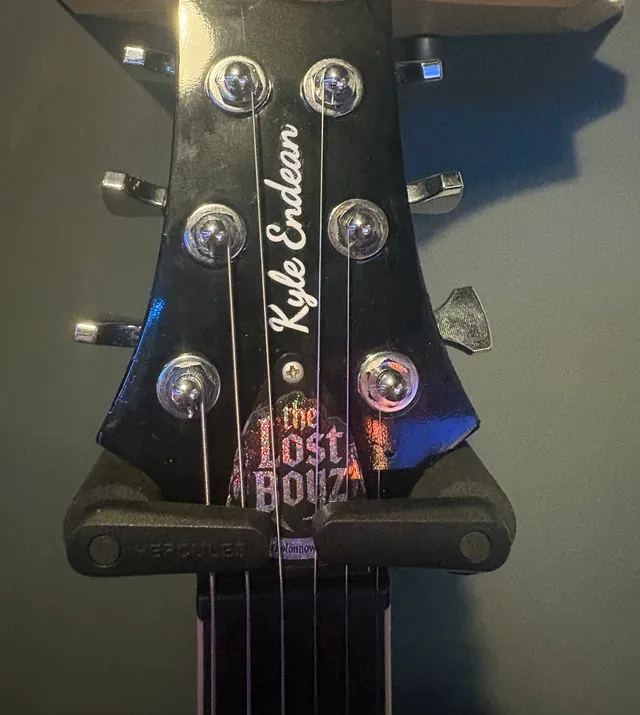
Darren does his own work on the guitars. At present these are the modifications he has made:
- Bridge
- Factory block removed and replaced with a brass block.
- Saddles
- Graph Tech String Saver high performance saddles.
- Nut
- Graph Tech Black TUSQ.
- Tuners
- Hipshot Grip-Lock.
- Necks
- Rolled, for a more comfortable fit in the hand.
- Graphics
- Sheet black vinyl over both headstocks, then custom name vinyls made with the two boys' names on them, to rebrand both guitars with the Lost Boyz names.
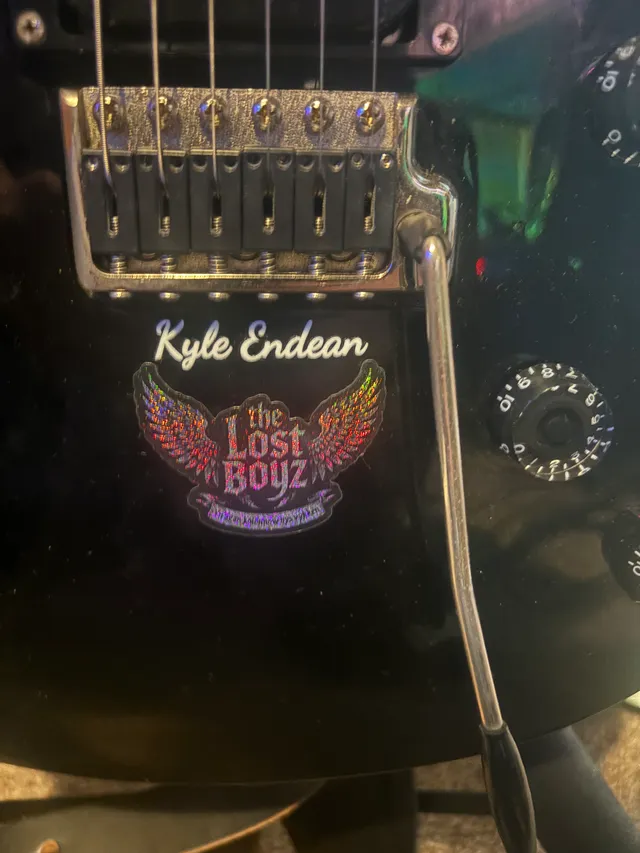
You will see the names of the boys on the headstock and behind the bridge of each guitar. Kyle is Darren's main guitar and Timmy is the backup. There is a Lost Boyz sticker behind the bridge too.
On the back of each guitar there is a white sticker on the headstock quoting “NEVER GIVE UP”, and a sticker on the back scratch plate that says SODS sweet chilli sauce — a tribute to someone who is very special to Darren.
Future plans
Darren plans to replace the frets with stainless steel ones, though not until he has worn the current ones out. And while he is happy with the pickups as they are, he is always researching how to improve the tone, so that could be on the cards as well.
On the floor
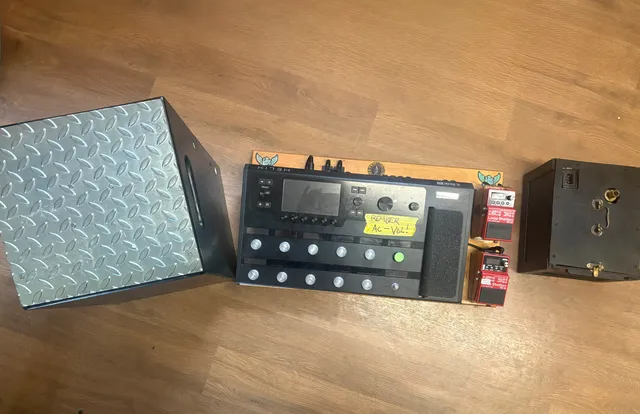
The pedalboard
It gets a bit more tricky here.
The Line 6 Helix
This is the brain of the whole rig, and the master controller.
In the first set Darren uses specific programs to control the acoustic guitar and amp, so at that point the Helix is a bog standard pedalboard, so to speak. Once the acoustic set is finished he switches off the Marshall acoustic amp and mutes that channel at the TS8. The settings on the Helix are then changed over to the electric set.
The Helix has multiple outputs: one goes to the acoustic amp, one to the TS8, and one to Darren's custom built talk box.
For each song Darren programs the Helix by assigning a different switch to each part of the song — intro, verse, chorus, solo and so on. Doing it that way, the Helix becomes whichever amplifier and whichever pedals Darren wants to add or take away at that moment, and sends the signal wherever it needs to go. It is a lot of hours of programming, but it avoids pedalboard tap dancing.
Looper 1
The Helix connects to a Boss RC-5 looper over MIDI, and that is where all the backing tracks are stored. Each time Darren changes song on the Helix, the looper changes track as well, so when he presses it with his foot the right backing track begins to play.
The RC-5 has two outputs. Output 1 goes to the TS8, which is what the crowd hear. Output 2 goes to Andrew's in-ear monitoring at the drum kit.
Andrew has his own custom mix going to his in-ears so that he can hear a click track, and that is what lets him keep time with the pre-recorded backing. Without it The Lost Boyz would not work, because there would be no beat — the drums are played live rather than pre-recorded like the rest of the backing. This was the first obstacle the boys hit when they formed. Generally a band plays in time to a drummer; in The Lost Boyz' case Andrew has to play in time with a band, so technically the whole thing is the wrong way round.
Looper 2
Again this is a Boss RC-5. It is connected to Looper 1 over MIDI and starts automatically when Looper 1 does. Looper 2 has the click tracks for all the songs on it, but Darren has converted them in the studio to a kick drum beat, and that goes to his custom made foot rest — the one he calls the Jack in a Box.
The Jack in a Box
Sometimes, on the more difficult guitar solos, Darren finds it easier to be in a more sat down position, and that is where the foot rest idea came from. He can put his foot on it and rest the guitar on his left leg — in a live situation he cannot actually sit down.
So what makes the Jack in a Box unlike any other foot rest?
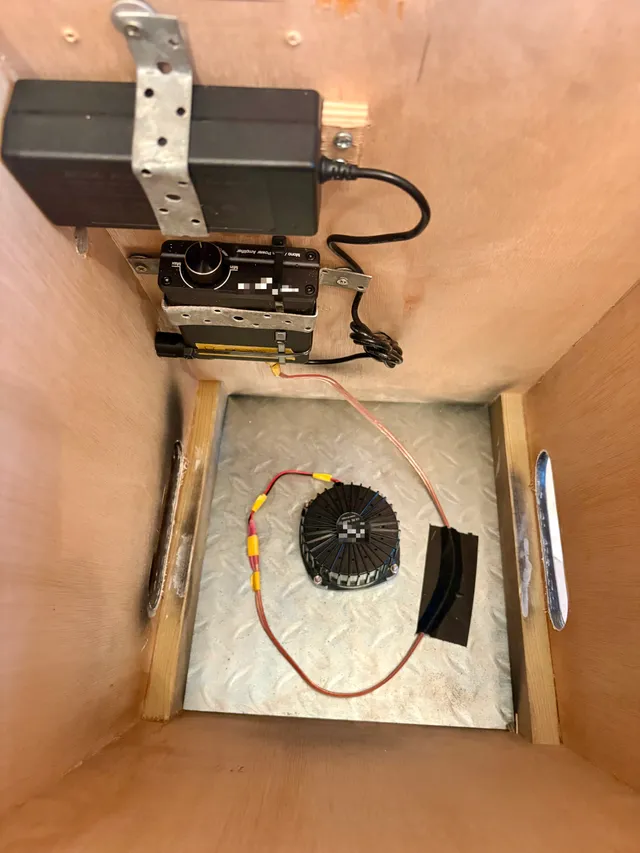
Because the drums are electronic you lose the feel when playing live, so Darren has installed a 100w subwoofer amplifier and a tactile transducer inside the foot rest. The subwoofer amp is connected to Looper 2, so when he is playing he can put his foot on the rest and literally feel the beat of the music — a metronome you can feel instead of hear.
Sod, Darren's cousin's husband and a close friend, was given the job of building the foot rest while Darren did the electronic side.
The talk box
Darren was struggling to find a talk box powerful enough to do what he wanted, so he went to his physics teacher from school and long-time friend Dave for some help, knowing Dave had made one successfully in the past.
There are four parts to it. First an amplifier to power it. Then the harder thing to find: the driver, which had to be full range to stop it blowing — a compression driver of the sort found in fairground speakers. Darren's dad Mike was given the task of helping make a reducer, to bring the throat of the driver down to a size that suited the pipe. Finally a box was needed to hold it all together, so Mike made that too.
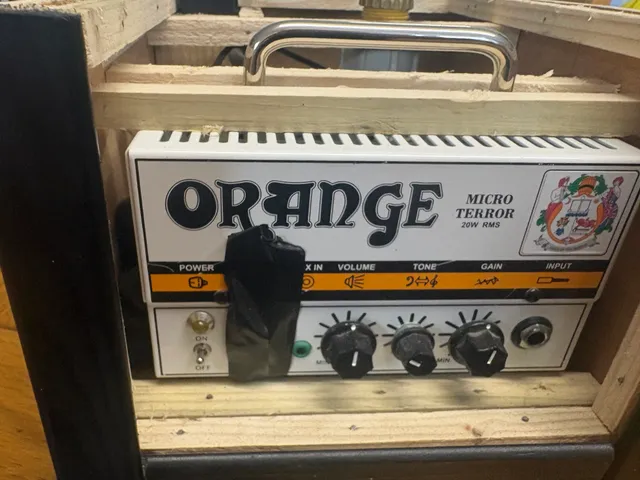
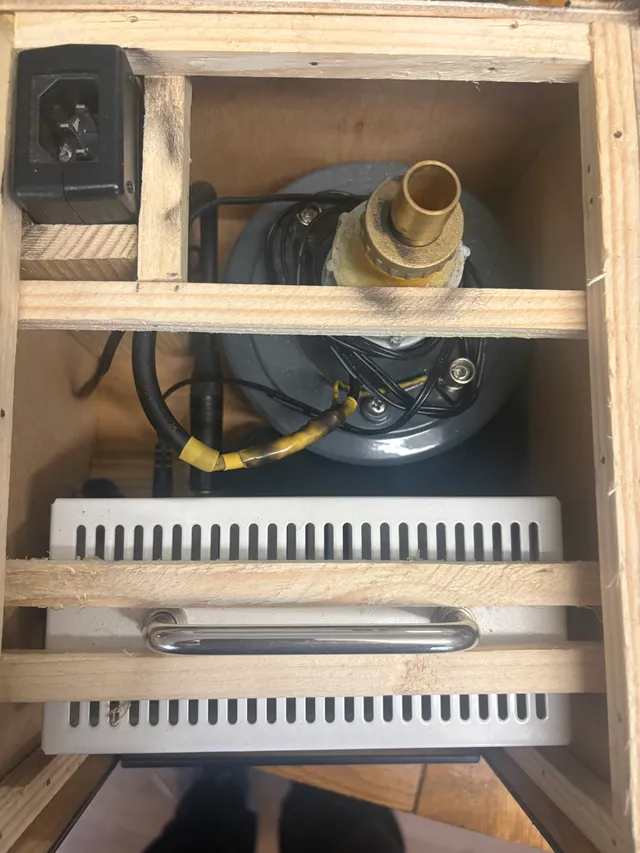
The talk box is then connected to some garden hose adapters and a fishpond hose, which takes the sound up to Darren's second microphone. That is why Darren has two mics — one of them is purely for the talk box. Like everything else, it is turned on and off from the Helix.
This is Sod and Mike
The guys behind the scenes. If woodwork is needed, these are the guys.